
We welcomed Gemma Moore and Rick Davies to the second of the Lancaster Evaluation Group’s (LEG) hybrid seminar series, discussing “Participatory and collaborative approaches to evaluation.”
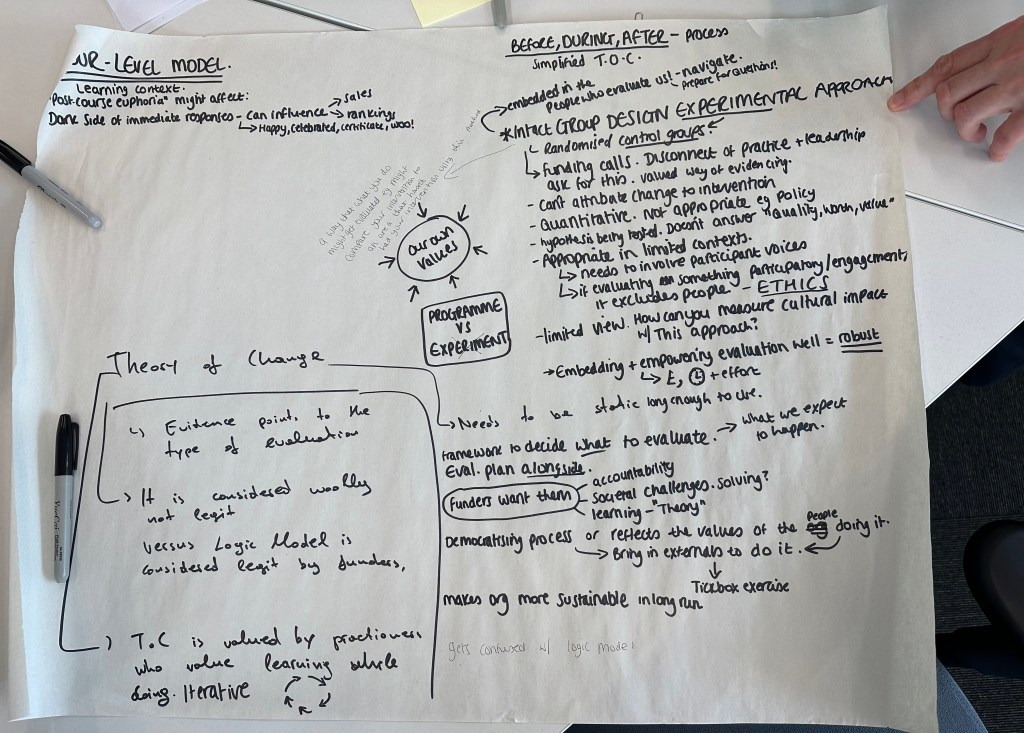
Gemma presented her work on “Coproducing evaluations: Evaluation that Engages.” Voluntary and community organisations in the UK want, and are under pressure to, improve their capacity to evaluate their work, whilst universities have corresponding research skills and expertise. Within this session, we share a case study of how a university has respond to this need: the Evaluation Exchange. The Evaluation Exchange is a partnership between UCL and a community-infrastructure organisation Compost London . It is a structured 6-month programme that matches interdisciplinary teams of researchers with organisations to improve their capacity to evaluate their work. Rather than seeking to develop or promote one specific evaluation method we bring together different stakeholders with a range of skills, knowledge, and expertise to co-produce a bespoke solution that best fits the circumstances. Within this session we provide an introduction to the principles underlying the Evaluation Exchange, define what we mean by ‘co-productive evaluation’ , and outline some tensions of putting the principles to practice. We share the learning from delivering the programme, reflecting on the building capacity and capabilities in evaluation practice, supporting a shift in traditional evaluation practice.
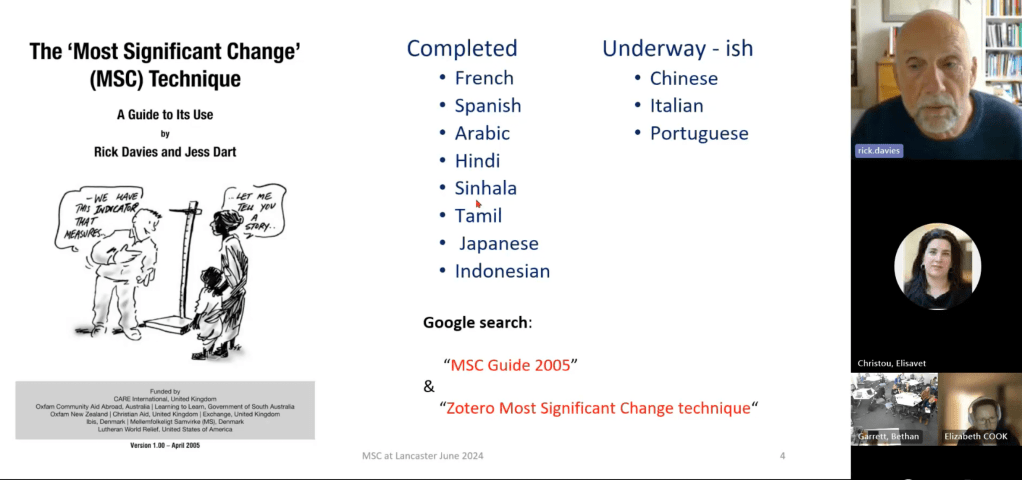
Rick Davies presented his work on “The Most Significant Change” (MSC) technique: Its origins, how it works, and how it has been used 1994-2024.” This presentation will describe the context in which MSC was developed and used, initially in a PhD thesis focused on field work conducted in 1994 Bangladesh. It will then explain the 10 steps in the design and use of a MSC process, as described in detail in the 2005 MSC Guide, describe some of the ranges of use of MSC since then, as accessible in the Zotero Online MSC Bibliography and present Rick’s own assessment of the uses of the method, in light of its original design intentions.



 Lancaster Evaluation Group
Leave a comment